UEFA Champions League Winners List: Every Champion Since 1956
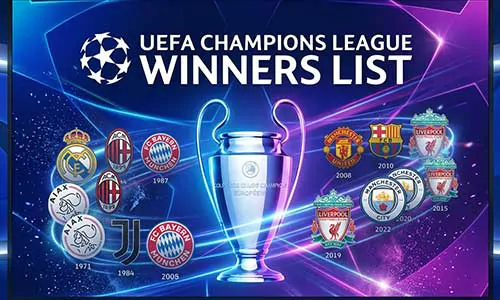
The UEFA Champions League is widely regarded as the ultimate stage in club football. Since its inception in 1955 as the European Champions’ Cup, this legendary tournament has crowned the undisputed kings of European football. From Real Madrid’s early supremacy in the late 1950s to Paris Saint-Germain’s historic back-to-back triumphs in 2025 and 2026, the history of this competition is filled with iconic matches, stunning upsets, and legendary dynasties. Winning this trophy represents the absolute pinnacle of club achievement.
For football fans and historians alike, tracing the champions of Europe is a journey through the evolution of the beautiful game. In this comprehensive guide, we present the complete UEFA Champions League winners list, analyze the most successful clubs and countries, and break down the historic eras of dominance that have shaped European football history.
Table of Contents
- 1. The Rich History of the European Cup and Champions League
- 2. Complete UEFA Champions League Winners List (1956 – 2026)
- 3. Most Successful Clubs in UEFA Champions League History
- 4. UEFA Champions League Titles by Country
- 5. Historical Eras of Dominance in European Football
- 6. Frequently Asked Questions (FAQ)
The Rich History of the European Cup and Champions League
The competition was founded in 1955, originally named the European Champion Clubs’ Cup, or simply the European Cup. Initially, it was a straight knockout tournament reserved exclusively for the domestic league champions of UEFA-affiliated nations. Consequently, the tournament was highly exclusive, and domestic giants had to win their leagues just to earn a ticket to the continental stage.
However, the landscape of European football shifted dramatically in the 1992–93 season. UEFA rebranded the competition as the UEFA Champions League, introducing a group stage and eventually expanding the tournament format to include multiple entries from top-performing leagues. This rebrand transformed the competition into a multi-billion dollar global spectacle, significantly increasing both the quality of play and the competitive drama.
Recently, the tournament underwent another massive evolution. The 2024–25 season saw the introduction of the revolutionary “Swiss Model” league phase, which replaced the traditional group stage with a single 36-team table. This historic change has heightened the stakes, ensuring more blockbuster clashes early in the competition and keeping fans on the edge of their seats from start to finish.
Complete UEFA Champions League Winners List (1956 – 2026)
Below is the complete list of every champion since the tournament’s inaugural season in 1955–56. This table details the winner, runner-up, final score, and the venue that hosted the prestigious showcase event.
| Season | Winner | Score | Runner-up | Venue |
|---|---|---|---|---|
| 1955–56 | Real Madrid | 4–3 | Reims | Parc des Princes, Paris |
| 1956–57 | Real Madrid | 2–0 | Fiorentina | Santiago Bernabéu, Madrid |
| 1957–58 | Real Madrid | 3–2 (aet) | AC Milan | Heysel Stadium, Brussels |
| 1958–59 | Real Madrid | 2–0 | Reims | Neckarstadion, Stuttgart |
| 1959–60 | Real Madrid | 7–3 | Eintracht Frankfurt | Hampden Park, Glasgow |
| 1960–61 | Benfica | 3–2 | Barcelona | Wankdorf Stadium, Bern |
| 1961–62 | Benfica | 5–3 | Real Madrid | Olympisch Stadion, Amsterdam |
| 1962–63 | AC Milan | 2–1 | Benfica | Wembley Stadium, London |
| 1963–64 | Inter Milan | 3–1 | Real Madrid | Praterstadion, Vienna |
| 1964–65 | Inter Milan | 1–0 | Benfica | San Siro, Milan |
| 1965–66 | Real Madrid | 2–1 | Partizan | Heysel Stadium, Brussels |
| 1966–67 | Celtic | 2–1 | Inter Milan | Estádio Nacional, Lisbon |
| 1967–68 | Manchester United | 4–1 (aet) | Benfica | Wembley Stadium, London |
| 1968–69 | AC Milan | 4–1 | Ajax | Santiago Bernabéu, Madrid |
| 1969–70 | Feyenoord | 2–1 (aet) | Celtic | San Siro, Milan |
| 1970–71 | Ajax | 2–0 | Panathinaikos | Wembley Stadium, London |
| 1971–72 | Ajax | 2–0 | Inter Milan | De Kuip, Rotterdam |
| 1972–73 | Ajax | 1–0 | Juventus | Red Star Stadium, Belgrade |
| 1973–74 | Bayern Munich | 4–0 (Replay) | Atlético Madrid | Heysel Stadium, Brussels |
| 1974–75 | Bayern Munich | 2–0 | Leeds United | Parc des Princes, Paris |
| 1975–76 | Bayern Munich | 1–0 | Saint-Étienne | Hampden Park, Glasgow |
| 1976–77 | Liverpool | 3–1 | Borussia Mönchengladbach | Stadio Olimpico, Rome |
| 1977–78 | Liverpool | 1–0 | Club Brugge | Wembley Stadium, London |
| 1978–79 | Nottingham Forest | 1–0 | Malmö FF | Olympiastadion, Munich |
| 1979–80 | Nottingham Forest | 1–0 | Hamburg | Santiago Bernabéu, Madrid |
| 1980–81 | Liverpool | 1–0 | Real Madrid | Parc des Princes, Paris |
| 1981–82 | Aston Villa | 1–0 | Bayern Munich | De Kuip, Rotterdam |
| 1982–83 | Hamburg | 1–0 | Juventus | Olympic Stadium, Athens |
| 1983–84 | Liverpool | 1–1 (4–2 pen) | Roma | Stadio Olimpico, Rome |
| 1984–85 | Juventus | 1–0 | Liverpool | Heysel Stadium, Brussels |
| 1985–86 | Steaua București | 0–0 (2–0 pen) | Barcelona | Sánchez Pizjuán, Seville |
| 1986–87 | Porto | 2–1 | Bayern Munich | Praterstadion, Vienna |
| 1987–88 | PSV Eindhoven | 0–0 (6–5 pen) | Benfica | Neckarstadion, Stuttgart |
| 1988–89 | AC Milan | 4–0 | Steaua București | Camp Nou, Barcelona |
| 1989–90 | AC Milan | 1–0 | Benfica | Praterstadion, Vienna |
| 1990–91 | Red Star Belgrade | 0–0 (5–3 pen) | Marseille | Stadio San Nicola, Bari |
| 1991–92 | Barcelona | 1–0 (aet) | Sampdoria | Wembley Stadium, London |
| 1992–93 | Marseille | 1–0 | AC Milan | Olympiastadion, Munich |
| 1993–94 | AC Milan | 4–0 | Barcelona | Olympic Stadium, Athens |
| 1994–95 | Ajax | 1–0 | AC Milan | Ernst-Happel-Stadion, Vienna |
| 1995–96 | Juventus | 1–1 (4–2 pen) | Ajax | Stadio Olimpico, Rome |
| 1996–97 | Borussia Dortmund | 3–1 | Juventus | Olympiastadion, Munich |
| 1997–98 | Real Madrid | 1–0 | Juventus | Amsterdam Arena, Amsterdam |
| 1998–99 | Manchester United | 2–1 | Bayern Munich | Camp Nou, Barcelona |
| 1999–00 | Real Madrid | 3–0 | Valencia | Stade de France, Saint-Denis |
| 2000–01 | Bayern Munich | 1–1 (5–4 pen) | Valencia | San Siro, Milan |
| 2001–02 | Real Madrid | 2–1 | Bayer Leverkusen | Hampden Park, Glasgow |
| 2002–03 | AC Milan | 0–0 (3–2 pen) | Juventus | Old Trafford, Manchester |
| 2003–04 | Porto | 3–0 | Monaco | Arena AufSchalke, Gelsenkirchen |
| 2004–05 | Liverpool | 3–3 (3–2 pen) | AC Milan | Atatürk Olympic Stadium, Istanbul |
| 2005–06 | Barcelona | 2–1 | Arsenal | Stade de France, Saint-Denis |
| 2006–07 | AC Milan | 2–1 | Liverpool | Olympic Stadium, Athens |
| 2007–08 | Manchester United | 1–1 (6–5 pen) | Chelsea | Luzhniki Stadium, Moscow |
| 2008–09 | Barcelona | 2–0 | Manchester United | Stadio Olimpico, Rome |
| 2009–10 | Inter Milan | 2–0 | Bayern Munich | Santiago Bernabéu, Madrid |
| 2010–11 | Barcelona | 3–1 | Manchester United | Wembley Stadium, London |
| 2011–12 | Chelsea | 1–1 (4–3 pen) | Bayern Munich | Allianz Arena, Munich |
| 2012–13 | Bayern Munich | 2–1 | Borussia Dortmund | Wembley Stadium, London |
| 2013–14 | Real Madrid | 4–1 (aet) | Atlético Madrid | Estádio da Luz, Lisbon |
| 2014–15 | Barcelona | 3–1 | Juventus | Olympiastadion, Berlin |
| 2015–16 | Real Madrid | 1–1 (5–3 pen) | Atlético Madrid | San Siro, Milan |
| 2016–17 | Real Madrid | 4–1 | Juventus | Millennium Stadium, Cardiff |
| 2017–18 | Real Madrid | 3–1 | Liverpool | NSC Olimpiyskiy, Kyiv |
| 2018–19 | Liverpool | 2–0 | Tottenham Hotspur | Metropolitano Stadium, Madrid |
| 2019–20 | Bayern Munich | 1–0 | Paris Saint-Germain | Estádio da Luz, Lisbon |
| 2020–21 | Chelsea | 1–0 | Manchester City | Estádio do Dragão, Porto |
| 2021–22 | Real Madrid | 1–0 | Liverpool | Stade de France, Saint-Denis |
| 2022–23 | Manchester City | 1–0 | Inter Milan | Atatürk Olympic Stadium, Istanbul |
| 2023–24 | Real Madrid | 2–0 | Borussia Dortmund | Wembley Stadium, London |
| 2024–25 | Paris Saint-Germain | 5–0 | Inter Milan | Allianz Arena, Munich |
| 2025–26 | Paris Saint-Germain | 1–1 (4–3 pen) | Arsenal | Puskás Aréna, Budapest |
Most Successful Clubs in UEFA Champions League History
While many of Europe’s top clubs have touched the sky in this competition, a select few have established absolute dynasties. Dominating the UEFA Champions League requires a mix of elite talent, mental resilience, and tactical genius. Below is the breakdown of the most successful clubs in the tournament’s history.
- Real Madrid (15 Titles): Without a doubt, *Los Blancos* are the undisputed kings of Europe. They won the first five editions of the tournament and have maintained an unmatched aura in the Champions League, their latest triumph coming in 2024 against Dortmund.
- AC Milan (7 Titles): The Italian powerhouse dominated different generations, especially under Arrigo Sacchi in the late 1980s and Carlo Ancelotti in the 2000s.
- Bayern Munich (6 Titles): Germany’s most decorated club won an iconic hat-trick of titles in the 1970s and captured treble-winning glories in 2013 and 2020.
- Liverpool (6 Titles): Famously known for European magic nights, Liverpool has claimed six trophies, including the unforgettable “Miracle of Istanbul” comeback in 2005.
- Barcelona (5 Titles): With their signature *tiki-taka* style of football, Barcelona dominated the modern era, particularly under Pep Guardiola, capturing their last title in 2015.
- Paris Saint-Germain (2 Titles): Under the guidance of Luis Enrique, the French giants finally broke their continental curse in style. After a dominant 5–0 victory over Inter Milan in 2025, PSG achieved back-to-back glory in 2026 by defeating Arsenal on penalties in Budapest.
UEFA Champions League Titles by Country
When analyzing where the famous trophy has traveled over the decades, specific footballing nations emerge as dominant forces. Consequently, the national leagues of Spain, England, and Italy have historically produced the highest concentration of champions.
Spain leads the ranking primarily due to the overwhelming success of Real Madrid and Barcelona. England holds second place, showcasing a broader diversity of winners including Liverpool, Manchester United, Chelsea, Nottingham Forest, Aston Villa, and Manchester City.
| Country | Titles won | Winning Clubs |
|---|---|---|
| Spain | 20 | Real Madrid (15), Barcelona (5) |
| England | 15 | Liverpool (6), Manchester United (3), Chelsea (2), Nottingham Forest (2), Aston Villa (1), Manchester City (1) |
| Italy | 12 | AC Milan (7), Inter Milan (3), Juventus (2) |
| Germany | 8 | Bayern Munich (6), Borussia Dortmund (1), Hamburg (1) |
| Netherlands | 6 | Ajax (4), PSV Eindhoven (1), Feyenoord (1) |
| France | 3 | Paris Saint-Germain (2), Marseille (1) |
| Portugal | 4 | Benfica (2), Porto (2) |
Historical Eras of Dominance in European Football
To fully appreciate the evolution of the competition, we must look at the specific tactical eras that redefined how football was played on the continent.
Real Madrid’s Five-Year Dynasty (1956–1960)
In the early years of the European Cup, Real Madrid was completely untouchable. Led by legendary figures Alfredo Di Stéfano and Ferenc Puskás, they won the first five tournaments in a row. Their 7–3 victory over Eintracht Frankfurt in the 1960 final is still considered by many as one of the greatest football matches ever played.
The Rise of Dutch Total Football (1971–1973)
In the early 1970s, Ajax Amsterdam revolutionized the sport under the guidance of Johan Cruyff. Their fluid “Total Football” philosophy allowed players to seamlessly rotate positions. Consequently, they captured three successive European Cups, leaving an everlasting blueprint on modern tactical setups.
The German and English Power Shifts (1974–1984)
Following Ajax’s decline, Franz Beckenbauer’s Bayern Munich grabbed the torch, winning three straight titles. Soon after, English clubs took absolute control. Between 1977 and 1984, English teams won seven out of eight titles, with Liverpool dominating, Nottingham Forest achieving a sensational double under Brian Clough, and Aston Villa winning in 1982.
Modern Super-Clubs and PSG’s Emergence (2014–2026)
The modern era has been defined by super-clubs with immense financial power and tactical innovation. Real Madrid showcased an unprecedented three-peat from 2016 to 2018 under Zinedine Zidane. In addition, the competitive landscape witnessed the rising prominence of Paris Saint-Germain. PSG’s impressive tactical organization under Luis Enrique led them to victory in 2025 and a successful title defense in 2026, solidifying a new era of European competition.
Frequently Asked Questions About the UEFA Champions League
Q1: Which club has won the most UEFA Champions League titles?
Real Madrid holds the record for the most titles, having won the competition 15 times, starting with their initial five-consecutive streak from 1956 to 1960.
Q2: Who won the most recent UEFA Champions League final?
Paris Saint-Germain (PSG) won the 2026 final, defeating English side Arsenal on penalties (4–3) after a 1–1 draw in Budapest.
Q3: Has any team won the Champions League back-to-back in the modern era?
Yes. Real Madrid achieved a historic three-peat from 2016 to 2018. Additionally, Paris Saint-Germain won back-to-back titles in the 2024–25 and 2025–26 seasons.
Q4: When did the European Cup rebrand to the UEFA Champions League?
The competition was rebranded prior to the 1992–93 season, transitioning from a pure knockout format to include a group stage structure.
Q5: What was the format change introduced in the 2024–25 season?
UEFA introduced the “Swiss Model,” expanding the tournament to 36 teams playing in a single league phase instead of the traditional eight separate groups.
Q6: How many clubs have won the trophy undefeated?
Several teams have won undefeated, including Milan, Ajax, Manchester United, and Bayern Munich. Most recently, Bayern Munich won all their matches in the 2019–20 season.
Conclusion
The UEFA Champions League remains the absolute zenith of soccer, where legends are forged and history is written. Over seven decades, the cup has traveled from Madrid to Milan, Munich, Liverpool, and Paris, carrying with it the hopes of millions of supporters. For further official history and live match analysis, you can visit the Official UEFA Website or explore the detailed historical matches on Wikipedia’s List of Finals.
Who do you think will dominate the next era of European football? Will Real Madrid claim their 16th crown, or will we see a new giant rise to claim the ultimate prize? Let us know your predictions in the comments below!