Football Formations Guide: From 4-4-2 to Today’s Tactical Systems
Football Formations Guide: From 4-4-2 to Tactical Systems at the FIFA World Cup 2026
Football is often described as a game of opinions, but at its highest level, it is a game of space. Every millimeter on the pitch is contested, and how a manager chooses to distribute their players determines who controls that space. As excitement builds for the historic FIFA World Cup 2026, understanding the tactical blueprints of the game is more important than ever. From the rigid lines of the traditional 4-4-2 to the highly fluid, asymmetrical systems of today, tactical setups have evolved from simple positional templates into dynamic, reactive chess boards. This comprehensive football formations guide explores this evolution and highlights how modern coaches are preparing their squads for the ultimate test on the global stage.
Table of Contents
- 1. The Historical Evolution of Football Formations
- 2. The Classic 4-4-2: The Foundation of Modern Systems
- 3. The Dominance of the 4-3-3: Possession and High Pressing
- 4. The Versatile 4-2-3-1: Balancing Attack and Defense
- 5. The Resurgence of Three-at-the-Back: 3-5-2 and 3-4-2-1
- 6. Adapting Tactical Systems for the FIFA World Cup 2026
- 7. In-Possession vs. Out-of-Possession: Modern Fluidity
- 8. Tactical Trends to Watch at the FIFA World Cup 2026
- 9. Comparison Table of Major Football Formations
- 10. Frequently Asked Questions (FAQ)
1. The Historical Evolution of Football Formations
In the early days of organized football, tactics were almost entirely focused on attack. Formations like the 1-2-7 or the famous 2-3-5 “Pyramid” dominated the late 19th and early 20th centuries. These systems prioritized flooding the opposition’s penalty box with forwards. However, as defensive organization improved, managers realized they needed more balance. Consequently, the legendary W-M formation (3-2-2-3) was born in the 1920s, bridging the gap between defense and attack.
By the mid-20th century, tactical innovations in South America and Europe led to the birth of the back four. Brazil’s 4-2-4 system, which propelled them to World Cup glory in 1958, proved that defensive solidity did not have to come at the expense of attacking flair. Therefore, the stage was set for the introduction of structured, highly organized shapes that would define generations of coaches. Understanding these historical roots is vital as we analyze the complex tactical battles ahead of the FIFA World Cup 2026.
2. The Classic 4-4-2: The Foundation of Modern Systems
For decades, the 4-4-2 formation was the undisputed king of football tactics, particularly in English football. Its beauty lies in its simplicity, symmetry, and balance. The system features two flat banks of four players, consisting of four defenders and four midfielders, supporting two central strikers. Typically, one striker acts as a target man (physically dominant), while the second striker plays as a poacher or creative link-player.
Furthermore, the 4-4-2 provides excellent natural coverage of the pitch. Out of possession, the two blocks of four compress the space between the lines, making it incredibly difficult for opponents to play through the center. On the other hand, in possession, the wide midfielders can provide crosses for the two strikers, while the central midfielders orchestrate the play. Indeed, teams like Arrigo Sacchi’s AC Milan and Sir Alex Ferguson’s Manchester United perfected this shape to dominate European football.
Despite its historic success, the flat 4-4-2 has struggled against modern, three-man midfields. Consequently, many elite coaches have shifted away from it to avoid being numerically overrun in the center of the park. However, variations of the 4-4-2, such as the defensive low-block system perfected by Diego Simeone at Atlético Madrid, prove that the formation’s core principles remain highly effective in modern football.
3. The Dominance of the 4-3-3: Possession and High Pressing
If the 4-4-2 defined the late 20th century, the 4-3-3 has largely defined the 21st century. Popularized by Dutch “Total Football” and perfected by Pep Guardiola’s Barcelona, the 4-3-3 is designed for teams that want to dominate possession and dictate the tempo of the match. The formation utilizes a single holding midfielder (the pivot) and two creative central midfielders (interiors), flanked by two wide wingers and a central striker.
Crucially, the 4-3-3 creates natural passing triangles all over the pitch, facilitating smooth build-up play. In addition, it allows teams to execute a high-pressing defensive style. When possession is lost, the three forwards and advanced midfielders can instantly swarm the opponent to win the ball back high up the pitch. This strategy, often referred to as “Gegenpressing,” has been executed brilliantly by teams like Jurgen Klopp’s Liverpool.
Another key advantage of the 4-3-3 is the tactical flexibility of the wingers. Modern wingers are often “inverted,” meaning they play on the side opposite their dominant foot (e.g., a left-footed winger playing on the right). This allows them to cut inside and shoot, while the fullbacks overlap to provide width. This fluid dynamic makes the 4-3-3 one of the most difficult structures to defend against in world football today.
4. The Versatile 4-2-3-1: Balancing Attack and Defense
The 4-2-3-1 is perhaps the most balanced and widely used formation in contemporary football. It emerged in the early 2000s as a direct response to the defensive vulnerabilities of the 4-4-2 and the structural rigidity of other shapes. By employing a “double pivot” (two defensive midfielders) in front of the back four, this system provides unmatched defensive security while allowing four attacking players to cause chaos in the final third.
In this system, the “number 10” or central attacking midfielder plays a vital role. This player operates in the pockets of space between the opponent’s midfield and defense, serving as the main creative engine. Meanwhile, the double pivot allows the fullbacks to push forward aggressively, transforming the shape into a highly offensive 2-4-3-1 during attacking transitions. Therefore, it offers a perfect blend of stability and creative freedom.
Furthermore, the 4-2-3-1 transitions seamlessly into a compact 4-4-2 or 4-5-1 when defending. Because of this adaptability, many international managers prefer this system for major tournaments, where avoiding defensive errors is just as important as scoring goals. It remains a staple setup for elite national teams across the globe.
5. The Resurgence of Three-at-the-Back: 3-5-2 and 3-4-2-1
Tactical trends are cyclical, and nothing proves this more than the resurgence of three-at-the-back formations. Systems like the 3-5-2 and 3-4-2-1, which were incredibly popular in the 1980s and 1990s, have made a massive comeback in modern football. This resurgence is largely driven by managers who want to build play out from the back with a numerical advantage against two-striker systems.
The defining element of any three-at-the-back system is the role of the wingbacks. These players must possess exceptional stamina and tactical intelligence, as they are responsible for patrolling the entire length of the pitch. When attacking, they act as traditional wingers, stretching the opposition’s defensive line. Conversely, when defending, they drop back to form a solid five-man defensive unit.
Additionally, the 3-4-2-1 system employs two attacking midfielders (or “dual ten’s”) behind a lone striker. This creates immense central density, making it difficult for opponents to play through the middle. Managers like Antonio Conte and Thomas Tuchel have demonstrated how these structures can stifle opposition attacks while creating devastating counter-attacking opportunities.
6. Adapting Tactical Systems for the FIFA World Cup 2026
National team football is fundamentally different from club football. While club managers have months on the training pitch to drill intricate tactical movements, national team coaches only have brief international breaks to prepare. Consequently, successful coaches at the FIFA World Cup 2026 will need to strike a delicate balance between modern tactical sophistication and practical simplicity.
Historically, international tournaments have been won by teams with solid defensive foundations and highly organized structures. Therefore, we can expect many squads preparing for the FIFA World Cup 2026 to adopt flexible systems that minimize defensive risks while maximizing the individual brilliance of their star players. Striking the right balance between a compact mid-block and explosive transition play will be the ultimate key to success.
Moreover, the high-pressure environment of the FIFA World Cup 2026 will test the tactical adaptability of every coach. Managers cannot rely on a single, rigid game plan. They must prepare their teams to transition between multiple formations mid-game to exploit the specific weaknesses of their opponents. Those who can implement these tactical adjustments smoothly will likely go deep into the knockout rounds.
Adapting Tactical Systems for the FIFA World Cup 2026
To succeed at the elite level, managers must tailor their tactical frameworks to suit the unique characteristics of their squad. For instance, a team boasting exceptionally fast wingers might excel in a counter-attacking 4-3-3, while a squad with highly technical, possession-oriented midfielders might perform better in a structured 4-2-3-1. Tactical flexibility and game management will be more critical than ever during the upcoming tournament.
7. In-Possession vs. Out-of-Possession: Modern Fluidity
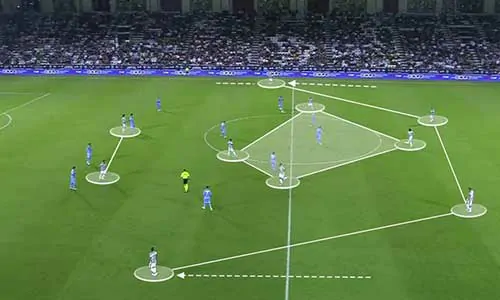
In modern football, talking about static formations like a “4-3-3” or “3-5-2” is only half the story. The elite teams of today utilize highly fluid shapes that change completely depending on whether they have the ball. For example, a team might line up on paper in a traditional 4-3-3 but transition into a 3-2-4-1 when in possession of the ball.
This tactical fluidity is achieved through the use of hybrid player roles. The most prominent example is the “inverted fullback.” Instead of overlapping down the touchline, the inverted fullback drifts into the central midfield during build-up play. This movement creates a box midfield, providing a numerical overload in the center of the pitch and protecting the team against counter-attacks through an organized “rest defense.”
The Role of Inverted Fullbacks and Hybrid Roles at the FIFA World Cup 2026
This blend of defensive stability and central overload will undoubtedly be a defining feature of tactics during the FIFA World Cup 2026. National teams with highly versatile players who can transition between multiple roles seamlessly will have a distinct advantage. Coaches will look to exploit these fluid movements to catch opponents off guard and dominate the key zones on the pitch.
Furthermore, we are seeing the rise of the “sweeper-keeper” and ball-playing center-backs who are comfortable stepping into midfield. These hybrid roles allow teams to build play directly from their penalty box, drawing the opponent’s press before exploiting the space left behind. These advanced tactical movements are expected to be a prominent feature at the FIFA World Cup 2026.
8. Tactical Trends to Watch at the FIFA World Cup 2026
As the footballing world looks ahead, several tactical developments are poised to take center stage. The expanded format of the FIFA World Cup 2026, featuring 48 teams, means we will witness a wider variety of tactical styles than ever before. Teams from different confederations will bring unique regional tactical philosophies, creating highly intriguing tactical matchups.
One major trend will be the battle between high-pressing systems and low-block defenses. Elite teams will look to press high up the pitch to force turnovers, while underdog teams may employ a highly compact low-block, looking to defend deep and hit on the counter-attack. The ability to break down a stubborn, well-organized low-block will be a major test for the tournament favorites.
Tactical Trends to Watch at the FIFA World Cup 2026
Another trend to monitor closely is the use of “out-of-possession” structures designed specifically to neutralize elite individual players. We will likely see advanced man-marking schemes and asymmetric defensive blocks tailored to shut down creative playmakers. This level of tactical preparation for the FIFA World Cup 2026 will make every single match an absolute chess match on grass.
Additionally, physical conditioning and squad rotation will play a massive role. The expanded travel schedule and diverse climates of the host nations (USA, Canada, and Mexico) will require squads to be highly efficient in their movements. Teams that can defend compactly without exerting excessive energy will be much better prepared to handle the physical demands of a grueling tournament run.
9. Comparison Table of Major Football Formations
To help you visualize the strengths and weaknesses of the primary tactical systems discussed in this guide, we have compiled a detailed comparison table below:
| Formation | Primary Focus | Key Strengths | Key Weaknesses | Best Suited For |
|---|---|---|---|---|
| 4-4-2 | Symmetry & Balance | Excellent pitch coverage; strong defensive banks. | Can be overrun in central midfield by 3-man systems. | Direct attacking & structured defensive low-blocks. |
| 4-3-3 | Possession & Pressing | Natural passing triangles; high-pressing efficiency. | Vulnerable to counter-attacks behind fullbacks. | Dominant, possession-based teams with fast wingers. |
| 4-2-3-1 | Adaptability & Control | Solid double pivot; great freedom for the playmaker. | Can become isolated if the wingers do not track back. | Balanced squads looking for defensive stability and attack. |
| 3-5-2 | Central Density | Overloads central areas; solid 3-man build-up. | Demands extreme physical fitness from wingbacks. | Counter-attacking teams and possession from the back. |
10. Frequently Asked Questions (FAQ)
To help deepen your understanding of these tactical concepts, we have answered some of the most common questions regarding modern football formations below:
Which formation is expected to dominate the FIFA World Cup 2026?
While no single formation dominates, variations of the highly adaptable 4-2-3-1 and fluid 4-3-3 systems will likely be heavily utilized at the FIFA World Cup 2026 due to their structural balance and ease of integration during short preparation windows.
What is the difference between a flat 4-4-2 and a diamond 4-4-2?
The flat 4-4-2 utilizes four midfielders in a straight line across the pitch, providing wide coverage. Conversely, the diamond 4-4-2 positions one midfielder defensively, two on the sides, and one attacking midfielder (forming a diamond shape), which prioritizes central control over wide play.
What does an “inverted fullback” do in modern football?
An inverted fullback drifts inside from their wide position into the central midfield during the attacking phase. This movement helps create defensive stability in the center of the pitch, creates passing lanes, and assists in dominating midfield possession.
Why are three-at-the-back formations becoming popular again?
Three-at-the-back formations are popular because they provide a numerical advantage when building play from the defense. They also offer excellent tactical flexibility, allowing teams to transition seamlessly into a five-man defense when out of possession.
How will travel and climate impact tactics at the FIFA World Cup 2026?
The physical demands of the FIFA World Cup 2026, featuring games across three vast nations, will force coaches to adopt structures that conserve player energy. Consequently, we may see teams utilizing compact mid-blocks rather than sustained, high-intensity pressing for full 90-minute periods.
Conclusion: The Ultimate Tactical Showcase
As tactics continue to evolve, formations remain the essential blueprint of how the beautiful game is played. From the structured reliability of the classic 4-4-2 to the highly fluid, hybrid systems utilized by modern tactical geniuses, the evolution of football shapes reflects the constant battle for spatial dominance. The tactical innovation on display at the FIFA World Cup 2026 will undoubtedly push the boundaries of the sport even further.
Whether you are a casual fan, a dedicated player, or an aspiring coach, understanding these systems enhances your appreciation of every pass, run, and defensive block. As we count down the days to the FIFA World Cup 2026, we can prepare to witness a masterclass in tactical warfare on the global stage.
Join the Tactical Discussion!
Which football formation do you think is the most effective in modern football? Will we see a tactical surprise at the tournament? Share your thoughts in the comments below!